

Choosing a nursing career is about more than deciding how long you want to spend in school. It also means thinking about your responsibilities, earning potential, work environment, and opportunities for career growth.
The difference between a Licensed Practical Nurse (LPN) and a Registered Nurse (RN) can influence all these factors. Both play important roles in patient care, but they follow different educational pathways and may have different responsibilities under state nursing regulations.
According to the U.S. Bureau of Labor Statistics (BLS), the national median annual wage for RNs was $97,550 in May 2025, compared with $64,400 for LPNs and LVNs. Employment projections also differ between the two occupations.
So, when comparing LPN vs RN, which path makes more sense for your goals? Understanding their scope of practice, salaries, education requirements, and job outlook can help you make an informed decision.
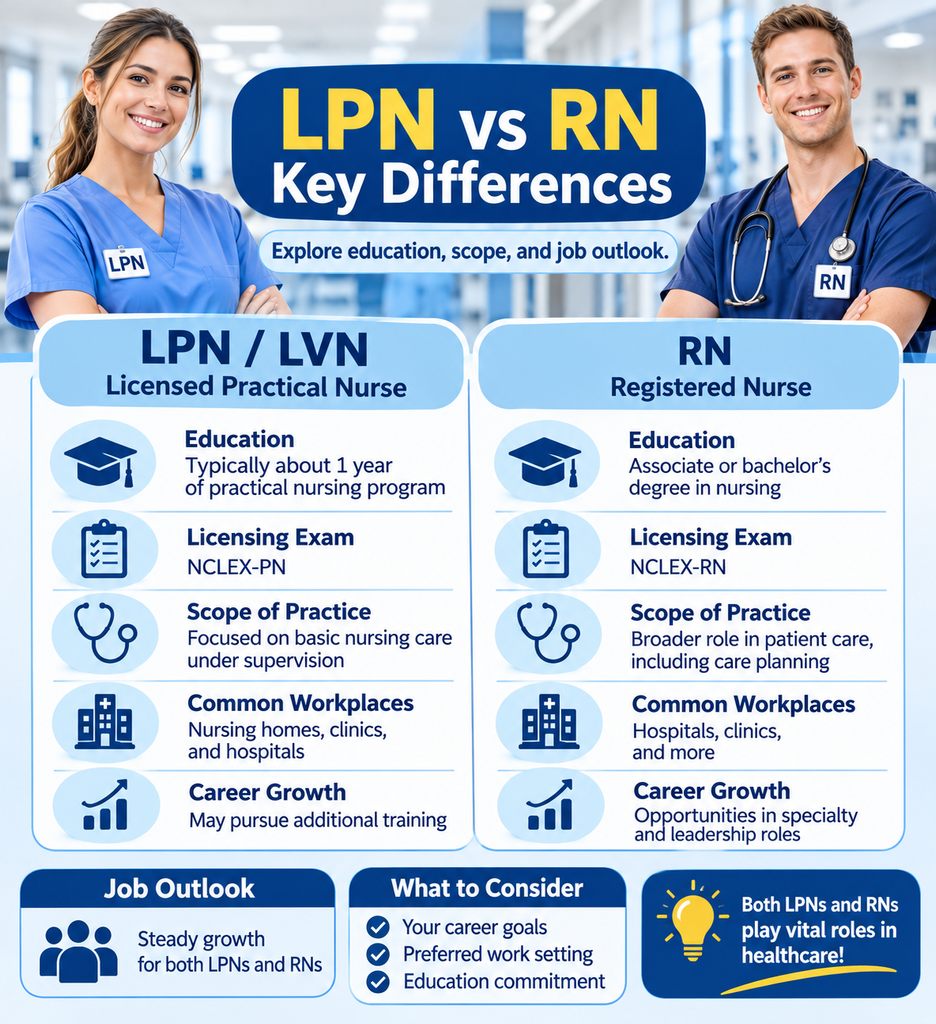
What Is an LPN and What Is an RN?
Although LPNs and RNs both provide nursing care, their responsibilities and educational requirements differ.
What Is a Licensed Practical Nurse (LPN)?
A Licensed Practical Nurse provides essential nursing care under the supervision or direction required by applicable state law and workplace policies. LPNs monitor patients, record vital signs, document care, assist with treatments, and report changes in a patient’s condition.
They commonly work in nursing and residential care facilities, hospitals, physicians’ offices, and home healthcare. LPNs are known as Licensed Vocational Nurses (LVNs) in California and Texas.
What Is a Registered Nurse (RN)?
A Registered Nurse provides and coordinates patient care, educates patients and families, and helps develop and evaluate care plans. Depending on the setting and applicable regulations, RNs may perform comprehensive assessments, coordinate treatment, delegate appropriate tasks, and collaborate with other healthcare professionals.
RNs work across hospitals, outpatient clinics, nursing facilities, home healthcare, and other settings. Their education can also support pathways into specialized nursing, leadership, and advanced nursing practice.
LPN vs RN: Key Differences at a Glance
The following table summarizes the main differences between LPNs and RNs.
| Factor | LPN/LVN | RN |
| Education | Approved practical nursing program, typically about one year | Approved associate degree, bachelor’s degree, or qualifying diploma pathway |
| Licensing exam | NCLEX-PN | NCLEX-RN |
| Scope of practice | Defined by state law, education, and competence | Generally broader, but still governed by state law and competence |
| Typical responsibilities | Patient monitoring, routine nursing care, documentation, and permitted treatments | Patient assessment, care planning, coordination, evaluation, and patient education |
| Common workplaces | Nursing facilities, residential care, clinics, and home healthcare | Hospitals, clinics, nursing facilities, home healthcare, and more |
| Career advancement | May pursue specialty training or an LPN-to-RN bridge program | May pursue specialty certifications, leadership, and further education |
| National median annual wage | $64,400 | $97,550 |
Wage figures are from BLS May 2025 data. Responsibilities vary by state, employer, patient needs, and the nurse’s qualifications.
The main distinction is that RNs generally have a broader scope of practice and more opportunities to pursue certain clinical and leadership roles. However, both professions provide valuable patient care.
LPN vs RN Scope of Practice: What Can Each Nurse Do?
Scope of practice refers to the professional activities a nurse is legally permitted and qualified to perform. The exact boundaries depend on state regulations, education, demonstrated competence, and workplace policies.
LPN Scope of Practice
LPNs provide direct patient care and help maintain patients’ comfort, safety, and well-being. Their responsibilities may include:
- Monitoring vital signs and observing changes in patient condition.
- Documenting patient information and nursing care.
- Administering medications and treatments when authorized.
- Assisting with daily care and prescribed nursing interventions.
- Communicating patient concerns and changes to the appropriate healthcare professional.
- Reinforcing patient education within their role and competence.
Some procedures, including particular types of IV therapy, may require additional training or may be restricted under state law or facility policy. Therefore, an LPN’s permitted duties should never be assumed to be identical in every state.
RN Scope of Practice
RNs generally have broader responsibilities in assessing patients, coordinating care, and evaluating treatment outcomes. Depending on their qualifications and setting, they may:
- Perform nursing assessments and identify patient care needs.
- Develop, implement, and evaluate nursing care plans.
- Monitor responses to treatment and communicate clinical concerns.
- Educate patients and families about health conditions and care instructions.
- Coordinate care with physicians and other healthcare professionals.
- Delegate appropriate tasks when permitted and provide required supervision.
An RN’s license does not automatically authorize every procedure or specialty activity. Nurses must still follow applicable laws, employer policies, and professional competency requirements.
What Is the Biggest Difference in Their Scope of Practice?
In general, RNs have greater responsibility for comprehensive nursing assessment, care planning, and coordination. LPNs provide nursing care within their defined scope and collaborate with other professionals as required.
The National Council of State Boards of Nursing (NCSBN) explains that state Nurse Practice Acts and related regulations govern nursing practice. Nurses should consult the board of nursing in the state where they intend to work rather than rely on a general comparison alone.
LPN vs RN Salary Difference in 2026
Salary is one of the most common reasons people compare these nursing career paths. National wage data show a difference, but individual earnings depend on several factors.
How Much Does an LPN Make?
The BLS reported a median annual wage of $64,400 for LPNs and LVNs in May 2025, equivalent to a median hourly wage of $30.96.
LPN earnings can vary depending on the state, employer, experience, and healthcare setting. For example, BLS data for May 2025 showed median annual wages of $68,020 in nursing and residential care facilities and $63,580 in home healthcare services.
How Much Does an RN Make?
The BLS reported a median annual wage of $97,550 for RNs in May 2025, equivalent to a median hourly wage of $46.90.
Earnings differ by industry. In May 2025, RNs working in hospitals had a median annual wage of $100,220, while those in nursing and residential care facilities had a median of $84,300.
LPN vs RN Salary Comparison
| Salary measure | LPN/LVN | RN |
| National median annual wage | $64,400 | $97,550 |
| National median hourly wage | $30.96 | $46.90 |
Difference between annual median wages: $33,150 in favor of RNs.
These figures come from the BLS Occupational Outlook Handbook. The $33,150 difference compares national medians; it does not mean every RN earns that much more than every LPN.
Location, overtime, shift differentials, experience, specialty, and employment arrangements can all influence actual pay. Per-diem nurses may also have different pay structures and benefit arrangements than full-time employees.
LPN or RN Education and Licensing Requirements
Education is another important factor when deciding which nursing path to pursue.
How Do You Become an LPN?
To become an LPN, candidates generally need to:
- Complete a state-approved practical nursing program, which typically takes about one year.
- Meet the applicable state board’s eligibility and application requirements.
- Pass the NCLEX-PN licensing examination.
- Obtain authorization to practice from the relevant state board of nursing.
Program duration and additional licensing requirements can vary.
How Do You Become an RN?
The RN pathway generally requires candidates to:
- Complete an approved nursing education program, such as an associate degree in nursing (ADN), a Bachelor of Science in Nursing (BSN), or another qualifying pathway.
- Meet state board requirements for licensure.
- Pass the NCLEX-RN examination.
- Obtain RN licensure before practicing.
An associate degree program is commonly described as a two-year pathway, although prerequisites and individual circumstances can extend the total time required.
Can an LPN Become an RN?
Yes. LPN-to-RN bridge programs provide a pathway for eligible LPNs to pursue RN education. Some programs may recognize prior learning or nursing experience, but admission criteria, transfer credits, clinical requirements, and completion time vary.
Before enrolling, compare program accreditation or approval, total cost, scheduling flexibility, and the licensing requirements in the state where you intend to work. The NCSBN licensing guidance is a useful starting point for checking state-specific requirements.
LPN vs RN Job Security and Career Outlook
Both occupations are expected to have employment opportunities, but the latest BLS projections show different growth rates.
LPN Job Outlook
Employment of LPNs and LVNs is projected to grow 3% from 2025 to 2035, about as fast as the average for all occupations. The BLS projects approximately 51,800 openings per year, on average, over the decade.
LPNs are employed in nursing and residential care facilities, hospitals, physicians’ offices, and home healthcare. Demand for care in residential and home settings, including services for older adults and people with chronic conditions, contributes to the occupation’s outlook.
RN Job Outlook
Employment of RNs is projected to grow 6% from 2025 to 2035, faster than the average for all occupations. The BLS projects approximately 180,800 openings per year, on average, over the same period.
RNs work across a wide range of settings, including hospitals, outpatient care centers, nursing facilities, and home healthcare. Their broad presence across the healthcare system contributes to the number of projected annual openings.
Which Career Offers Better Job Security?
Based on national BLS projections, the RN occupation has a higher projected growth rate and more annual openings than the LPN/LVN occupation. However, these figures do not guarantee employment for an individual nurse.
Job opportunities depend on local demand, experience, active licensure, qualifications, employer requirements, and the types of facilities hiring in a particular area. Annual openings also include replacement needs, such as when workers retire or move to other occupations, rather than only newly created jobs.
Sources: BLS LPN/LVN outlook and BLS RN outlook.
Career Growth: Is LPN a Dead-End Job?
No. Becoming an LPN is a legitimate nursing career, and it does not mean that professional growth has to stop. LPNs can build clinical experience, pursue relevant continuing education, and explore eligible specialty or supervisory opportunities.
For those who want broader responsibilities or additional career options, an LPN-to-RN bridge program may provide a route to RN licensure.
RNs can also pursue specialty certifications, leadership positions, and further education, including graduate nursing programs that may lead to advanced practice roles when all requirements are met.
Neither pathway guarantees promotion or higher earnings. Career growth depends on education, experience, professional interests, employer opportunities, and applicable licensing rules.
LPN vs RN: Which Career Is Better for You?
The better choice depends on your goals, resources, and preferred responsibilities.
An LPN pathway may be suitable if you:
- Want a comparatively shorter initial nursing education program.
- Hope to enter the nursing workforce sooner.
- Are comfortable working within the LPN scope of practice in your state.
- Want to gain experience before deciding whether to pursue further education.
An RN pathway may be suitable if you:
- Want broader nursing responsibilities.
- Are interested in a wider range of specialties or leadership opportunities.
- Can commit to the required education and licensing process.
- Want to keep additional educational and career pathways open.
Before deciding, compare tuition, program requirements, local wage data, and the types of roles available in your area. The best path is one that fits both your current circumstances and your longer-term career plans.
How MyShyft Can Support Flexible Nursing Work
For eligible healthcare professionals interested in per-diem opportunities, MyShyft connects qualified professionals with available shifts at participating healthcare facilities. LPNs and RNs can create a profile, submit required credentials, complete verification, and browse shifts that match their qualifications and availability.
Explore the MyShyft Healthcare Professionals page to learn more about the platform. Shift availability depends on location, credential status, facility demand, and staffing needs, so assignments are not guaranteed.
Choose the Nursing Path That Fits Your Goals
When comparing LPN vs RN, consider the differences in scope of practice, education, salary, and career outlook. RNs have a higher national median wage and stronger projected employment growth, while LPN programs typically provide a shorter initial route into nursing.
Neither career is automatically the right choice for everyone. Review state licensing requirements, compare local opportunities, and consider your long-term goals before making a decision. If flexible work is part of your plan, MyShyft is one platform where eligible LPNs and RNs can explore available per-diem shifts.
Frequently Asked Questions
References
- U.S. Bureau of Labor Statistics, Licensed Practical and Licensed Vocational Nurses
- U.S. Bureau of Labor Statistics, Registered Nurses
- National Council of State Boards of Nursing, Nurse Licensure Guidance
- National Council of State Boards of Nursing, Find Your Nurse Practice Act
- MyShyft, Healthcare Professionals
Disclaimer: This article is for general informational purposes and is not a substitute for official licensing guidance or professional advice. Nursing scope of practice and licensure requirements vary by state. Check with the relevant state board of nursing for current requirements.