
Your first CNA shift can be busy enough without realizing halfway through that you forgot your watch, your backup socks, or the shoes that do not leave your feet aching after eight hours.
A good CNA survival kit is not about carrying a huge medical bag. It is about having a few practical essentials that help you stay comfortable, prepared, organized, and ready to provide patient care.
The right items can make a long shift easier, especially when you work PRN or pick up shifts at different healthcare facilities.
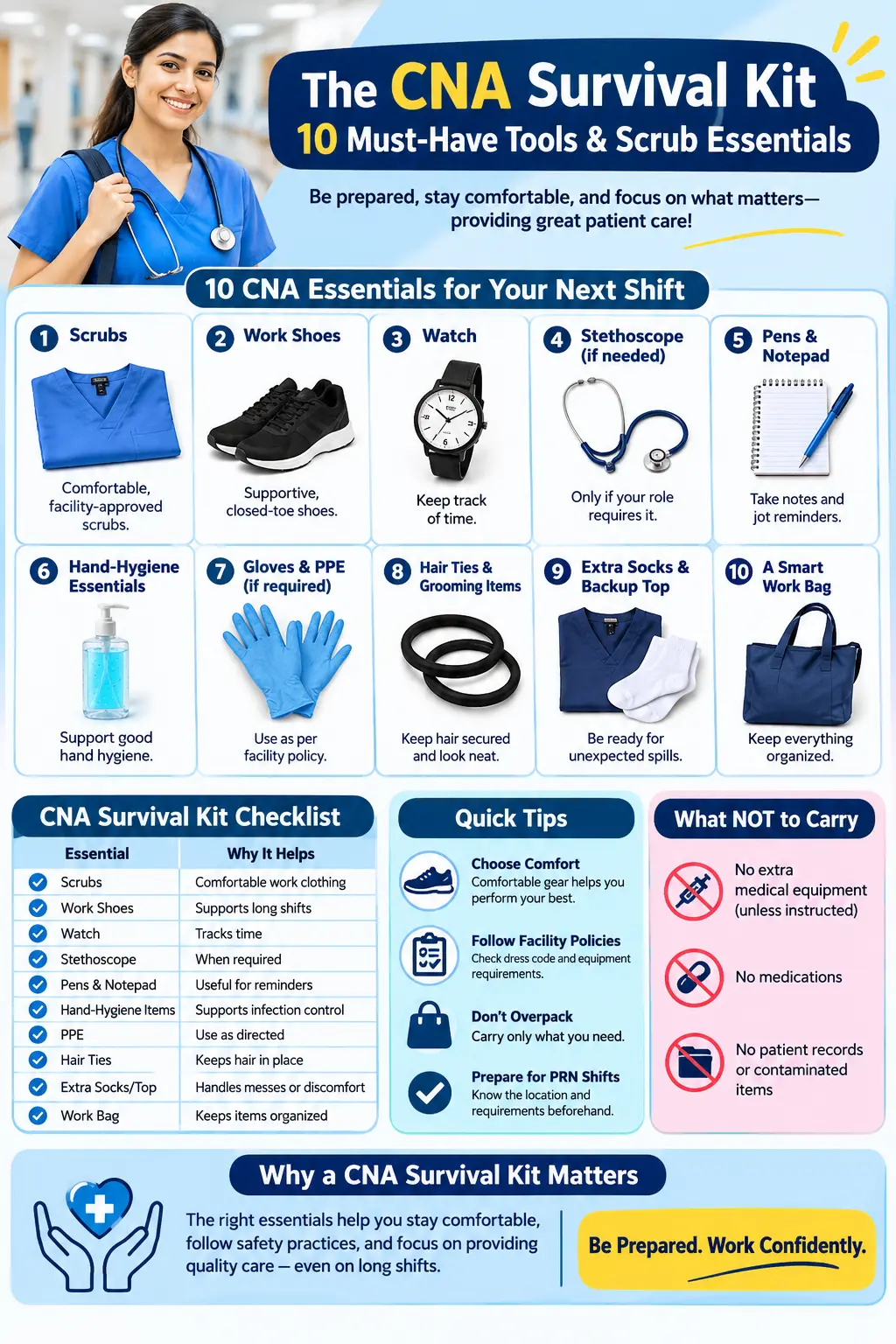
Here are 10 CNA must-have tools and scrub essentials worth considering before your next shift.
What Should a CNA Carry to Work?
What you need can vary depending on your employer, facility, assignment, and responsibilities. Some facilities provide certain supplies, while others may expect you to bring basic personal items.
Your CNA work bag should generally focus on three things: comfort, personal organization, and shift readiness.
You do not need to carry equipment that you are not trained or authorized to use. Always follow your facility’s policies regarding uniforms, equipment, PPE, jewelry, personal belongings, and infection control.
10 Must-Have CNA Tools & Scrub Essentials
1. Comfortable, Facility-Approved Scrubs
Scrubs are one of the most important parts of your CNA work wardrobe.
Choose a comfortable pair that allows you to bend, walk, reach, and assist patients without restricting movement. Check your facility’s dress code before buying multiple sets because some employers specify colors, styles, or materials.
If you work PRN at different facilities, it is useful to know the scrub requirements before each shift.
2. Supportive Closed-Toe Work Shoes
CNAs can spend much of a shift walking, standing, assisting patients, and moving between rooms.
A supportive pair of closed-toe work shoes can make a major difference in comfort. Look for shoes that fit properly, provide adequate support, and are appropriate for your workplace.
It can also be useful to keep a second pair available rather than relying on one pair every day.
OSHA identifies lifting and repositioning patients and musculoskeletal disorders among the safety concerns healthcare workers may face, making proper workplace practices and ergonomics important parts of CNA safety.
3. A Reliable Watch With a Second Hand
A watch is a simple item that can be surprisingly useful during a healthcare shift.
Depending on your responsibilities and facility policies, you may need to keep track of time during patient care activities or while coordinating your shift.
Choose something comfortable and easy to clean. If your facility has restrictions on watches, jewelry, or other accessories, follow those requirements.
4. A Stethoscope, If Your Role Requires One
Not every CNA needs to carry a stethoscope.
CNAs should only use equipment and perform tasks that fall within their training, role, and applicable state requirements. Some assignments may require or benefit from access to certain equipment, while others may not.
Before purchasing medical equipment, ask your employer what you actually need. There is little reason to spend money on equipment that your facility already provides or that you will not use.
5. Pens and a Small Notepad
A couple of reliable pens can save you from searching for one during a busy shift.
A small notepad can also be useful for permitted work-related reminders. However, be careful about patient privacy. Do not write down unnecessary protected health information or take patient information outside the facility.
Follow your employer’s privacy, documentation, and electronic-record policies.
6. Hand-Hygiene Essentials
Hand hygiene is one of the most important infection-prevention practices in healthcare.
The CDC recommends hand hygiene immediately before patient contact, after touching a patient or the patient’s surroundings, after contact with blood or body fluids, and immediately after removing gloves.
Facilities should provide appropriate hand-hygiene supplies, so you may not need to carry your own sanitizer. However, having a small personal sanitizer available when permitted can be convenient.
Remember that personal supplies never replace your facility’s infection-control procedures.
7. Gloves and Other PPE When Required
Personal protective equipment, or PPE, is selected based on the task and anticipated exposure.
The CDC recommends using appropriate PPE when exposure to infectious materials is expected. Depending on the situation, this can include gloves, gowns, masks, eye protection, or other protective equipment.
Do not assume you need to bring your own PPE. Many facilities provide it. Instead, know where PPE is located and understand your facility’s procedures for selecting, putting on, removing, and disposing of it.
8. Hair Ties and Simple Grooming Essentials
Long hair can become inconvenient during a busy shift, particularly when providing hands-on care.
Keeping a few hair ties in your CNA bag can help you keep your hair secured when needed.
Keep personal grooming items simple and workplace appropriate. Follow your facility’s rules regarding nails, jewelry, fragrances, hair, and other appearance requirements.
9. Extra Socks and a Backup Scrub Top
This is one of those CNA essentials you may not appreciate until you need it.
An extra pair of socks can be useful if your feet become wet or uncomfortable during a long shift. A backup scrub top can also help if your clothing becomes soiled during patient care.
You do not need to carry a complete second uniform every day. One or two practical backup items can be enough for most shifts.
10. A Small, Organized Work Bag
A good CNA work bag brings everything together.
Choose a bag that is large enough for your personal essentials without becoming so bulky that it gets in the way. Consider keeping separate sections for items such as:
- Pens and a notepad
- Personal hygiene items
- Hair ties
- Extra socks
- Backup scrub top
- Water bottle or permitted snacks
- Personal medication, if applicable
Keep patient information, medications, contaminated supplies, or facility property out of your personal bag unless your employer specifically directs you otherwise.
CNA Survival Kit Checklist
| Essential | Why It Helps |
| Facility-approved scrubs | Comfortable, appropriate work clothing |
| Supportive work shoes | Helps with long periods of standing and walking |
| Watch | Helps with time awareness when permitted |
| Stethoscope | Only when required or appropriate for your role |
| Pens | Useful for permitted work tasks |
| Small notepad | Helps with appropriate personal reminders |
| Hand-hygiene supplies | Supports good hand hygiene when permitted |
| PPE | Used according to facility procedures and task requirements |
| Hair ties | Keeps hair secured during work |
| Extra socks/scrub top | Useful for unexpected messes or discomfort |
| Work bag | Keeps personal essentials organized |
What Should You NOT Carry in Your CNA Bag?
More is not always better.
Avoid carrying unnecessary medical equipment, patient records, medications, contaminated items, or facility supplies in your personal bag. You should also avoid anything that conflicts with your facility’s safety or infection-control policies.
Your CNA bag should contain your personal work essentials, not become a portable supply closet.
Why Comfortable Gear Matters During Long CNA Shifts
CNA work can involve considerable standing, walking, bending, and assisting patients. OSHA specifically identifies patient lifting and repositioning as workplace hazards in nursing and residential care environments.
That makes comfort more than a convenience.
Shoes that fit properly, scrubs that allow movement, and a lightweight work bag can reduce unnecessary distractions during your shift. Your equipment should support your work rather than make it harder.
At the same time, personal gear cannot replace proper training, safe patient-handling procedures, or facility equipment.
How to Pack Your CNA Bag for a PRN Shift
PRN work can mean working at different facilities, so preparation matters.
Before leaving home, check the shift information and confirm the facility location, start time, dress requirements, and any special instructions. MyShyft, for example, allows healthcare professionals to review shift details such as facility, time, pay rate, and notes before selecting and confirming shifts.
A simple pre-shift checklist can include:
Scrubs → shoes → ID → watch → pens → hair ties → backup socks → personal essentials → water/snack if permitted.
Taking five minutes to prepare can prevent unnecessary stress when you arrive.
Do CNAs Need to Buy Their Own Medical Equipment?
Not necessarily.
Whether a CNA needs personal equipment depends on the employer, facility, assignment, and scope of practice. Some facilities provide the equipment required for the job.
Before purchasing anything expensive, ask what you are expected to bring. This can prevent you from spending money on equipment that is unnecessary for your role.
Your priority should be having the basic items that help you work safely and comfortably.
How to Build a CNA Survival Kit Without Overspending
You do not need to buy everything at once.
Start with the basics: comfortable scrubs, reliable shoes, a watch if permitted, pens, and a practical work bag. Add other items based on your actual experience.
After a few shifts, you will quickly discover what you use every day and what stays at the bottom of your bag.
If you work PRN, consider keeping a small duplicate kit in your car or work bag so you are not constantly moving items between bags.
How MyShyft Can Help CNAs Prepare for Different Shifts
For CNAs looking for flexible work, MyShyft connects healthcare professionals with facilities offering flexible shift opportunities. Professionals can create a profile, complete credentialing, get activated, and then browse and apply for available shifts.
Because shift details can vary, reviewing the assignment before confirming it is an important part of preparation. MyShyft recommends checking the date, time, location, and availability before confirming a shift.
That same preparation mindset applies to your CNA survival kit: know where you are going, understand what the shift requires, and bring what you actually need.
Common CNA Gear Mistakes to Avoid
A few common mistakes can make your shift more difficult.
- Buying equipment you do not need: Check your employer’s requirements before spending money.
- Choosing style over comfort: A great-looking pair of shoes is not helpful if you cannot comfortably wear them for a full shift.
- Ignoring facility policies: Scrub colors, accessories, nails, shoes, and personal items may have specific requirements.
- Overpacking: A heavy, cluttered bag creates another problem to manage.
- Forgetting backups: Extra socks or a spare scrub top can be useful when unexpected situations happen.
- Treating personal supplies as a substitute for PPE: Always follow facility infection-control procedures and use the PPE appropriate for the task. The CDC emphasizes risk-based PPE selection and hand hygiene as part of Standard Precautions.
Conclusion
A CNA survival kit does not need to be complicated. The goal is to arrive prepared without carrying unnecessary equipment.
Start with the essentials: comfortable scrubs, supportive shoes, a reliable watch if permitted, pens, basic personal supplies, and a practical bag. Then adjust your kit based on your facility, assignment, and experience.
For CNAs working PRN, preparation becomes even more useful because every facility and shift may have slightly different expectations. Checking the assignment details ahead of time and keeping your essentials organized can help you start each shift with fewer distractions.
FAQs About CNA Essentials
References
- Centers for Disease Control and Prevention (CDC). Hand Hygiene.
- CDC. Standard Precautions for Patient Care.
- Occupational Safety and Health Administration (OSHA). Safe Patient Handling.
- OSHA. Work-Related Musculoskeletal Disorders.
- MyShyft. For Healthcare Professionals.
Disclaimer: This article is intended for informational and educational purposes only. The CNA tools and essentials discussed are general recommendations and may vary depending on your employer, healthcare facility, job responsibilities, and state regulations. Always follow your facility’s policies, infection-control procedures, and scope-of-practice requirements. Consult your employer before purchasing or using medical equipment for your role.